THE AI TURNING POINT · SAMPLE CHAPTER
We’ve Seen This Movie Before.
Read Chapter 1 from Jim Spignardo’s book about the systems AI reveals, and the leadership choices that turn early friction into progress.
CHAPTER 1
Published with permission of the author. This sample chapter is an excerpt from The AI Turning Point.
The meeting was supposed to be a quick win.
A team had rolled out a new AI assistant inside tools that everyone already used. The demo landed. The screenshots looked sharp. Leadership nodded. Two weeks later, the tone shifted.
“It’s making things worse,” someone said. “Worse how?” “It gives answers, but they’re wrong in subtle ways. We spend more time fixing them than starting from scratch.”
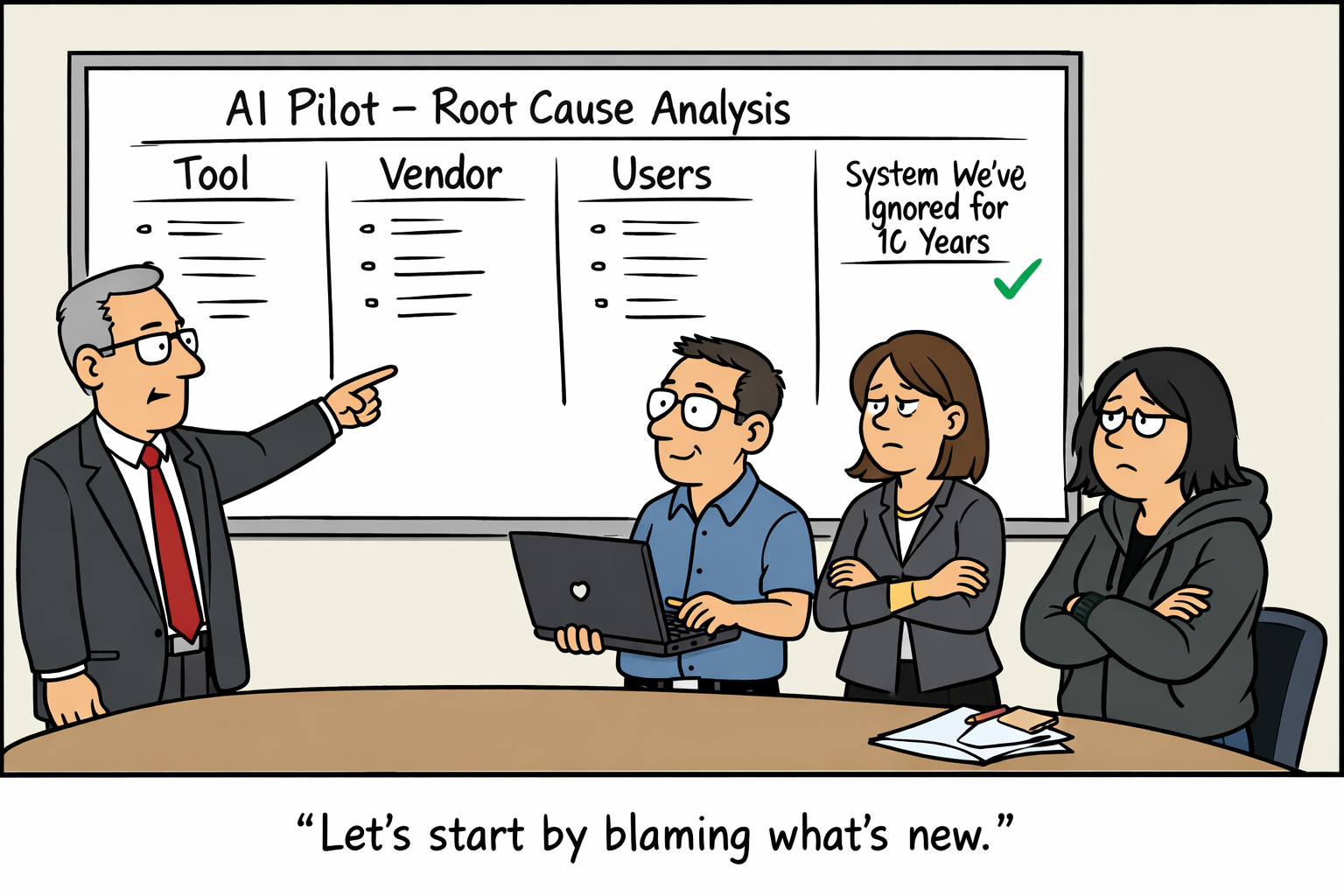
The instinct was immediate and familiar. The tool must be the problem.
It rarely is.
That moment echoed earlier transitions almost perfectly. Not emotionally. Structurally.
In the early 2000s, email adoption exploded across knowledge work. Within a few years, complaints followed. University of California, Irvine researcher Gloria Mark has reported that people typically take 23 minutes and 15 seconds to return to their work after an interruption. Productivity anxiety surged. Email wasn’t making work better. It was fragmenting attention.
The technology didn’t change. Work adapted.
Filters improved. Norms formed. People learned when not to respond immediately. The system around email matured, and the panic faded.
The same pattern repeated with the cloud.
In 2010, security, governance, and loss of control were central barriers to cloud adoption. Executives worried about compliance exposure and opaque risk. Those fears were not irrational. Early governance models were immature, and tooling lagged behind ambition.
Fast forward a decade. Cloud-first principles have become a normal part of enterprise technology strategy, and cloud outages are no longer viewed as existential threats. They are operational events. The shift didn’t happen because the cloud became magical. It happened because governance, visibility, and responsibility models caught up.
Artificial intelligence now occupies the same phase of the cycle, but with higher emotional voltage.
According to the 2024 Microsoft Work Trend Index, 75 percent of knowledge workers reported using AI at work, while 60 percent of leaders worried that their organization’s leadership lacked a plan and vision to implement it. Adoption was happening faster than alignment. That gap is where frustration lives.
Pew Research adds another layer. In a 2023 survey, 52 percent of U.S. adults said they felt more concerned than excited about the increased use of AI in daily life, while 33 percent said they had heard a lot about AI. Anxiety rises when understanding lags behind capability.
This is not a failure of education or intent. It’s a failure of systems to keep pace with tools.
When AI produces low-quality or misleading output, it is almost always operating on fragmented information. Data ownership is unclear. Content is outdated. Institutional knowledge lives in inboxes, shared drives, or someone’s head. AI doesn’t resolve that chaos. It faithfully reflects it.
Research from MIT Sloan supports this observation. Studies on human-AI collaboration show that AI improves performance most significantly in environments with high data clarity and process consistency. At the same time, outcomes degrade sharply when inputs are ambiguous or poorly governed.
In other words, AI doesn’t introduce disorder. It accelerates whatever already exists.
This explains why reactions to AI feel sharper than past shifts. Email annoyed people. The cloud challenged control. AI challenges judgment. When the output feels wrong, people don’t blame latency or uptime. They question trust.
History tells us what happens next.
Organizations that treat this as a tooling problem chase better prompts, better models, or better vendors. Organizations that adapt treat it as a design problem. They clarify ownership. They clean up information flows. They make decisions about what matters enough to be accurate.
That’s how previous revolutions settled into normalcy. Not through spectacle, but through discipline.
We have seen this movie before. The plot twist is never the technology. It’s whether organizations are willing to confront the systems they’ve been postponing fixing.
Northstar: A Moment in Practice
Northstar didn’t roll out the new platform with fanfare. There was no countdown clock. No transformation slogan. Just a carefully worded announcement about improving productivity, reducing time spent searching for information, and giving people back a little space in their day.
Alex believed in the move. Not blindly, but pragmatically. Clients were asking sharper questions. Competitors were talking loudly about AI. Doing nothing felt riskier than doing something. Early demos looked promising, and early feedback was cautiously optimistic. That was enough to move forward.
The first signs of friction arrived quietly.
Some teams reported strong results. Others complained the answers felt off. A few people said the tool worked “most of the time,” which sounded reassuring until Alex realized no one could define what “most” meant. Leadership meetings began to include phrases like inconsistent, needs tuning, and user education.
Jordan saw the pattern immediately. Same tool. Same configuration. Radically different experiences. Jordan pulled a few examples and traced them back to their sources. The inputs were uneven. The underlying content told different stories depending on who had touched it last. None of this was new. The tool was simply surfacing what had been easy to ignore before.
Jordan drafted a note outlining the risks of pushing forward without addressing context and ownership. It was thorough. It was accurate. It landed with a thud. The response was polite and noncommittal. There would be time to address that later.
Sam felt the tension building from both sides. Leadership wanted reassurance. Teams wanted answers. Sam spent days translating feedback upward and expectations downward, smoothing edges, reframing concerns, buying time. The work Sam was hired to do kept slipping to the bottom of the list, replaced by work that no one had explicitly asked for but everyone seemed to need.
Pat noticed something different. The tool wasn’t wrong, exactly. It was just incomplete. Pat filled in the gaps instinctively, the same way they always had. Cross-checking here. Adjusting there. Getting the work done without making noise. Pat had learned that early friction was temporary. Systems eventually caught up. Or people learned to work around them.
By the end of the first month, Northstar had data. Adoption numbers looked healthy. Usage was up. Leadership presentations showed progress. But beneath the metrics, something familiar was taking shape.
The organization was asking the same question it always did when something new arrived.
Is the tool the problem?
And once again, the more uncomfortable question went unasked.
Inflection Point: Diagnose the System Before Blaming the Tool
For Executive Leadership
- Pause tool-blame narratives when early friction appears. Ask what systems the tool inherited.
- Compare current AI reactions to past technology transitions in your organization. Look for repeating mistakes.
- Signal that early discomfort is expected and informative, not a failure.
For Technology Leadership
- Document where AI tools are being tested and what environments they land in.
- Separate “the tool failed” from “the system wasn’t ready” in every postmortem.
- Stop treating early pilots as proofs of value. Treat them as diagnostics.
For People and Operations
- Normalize learning curves publicly. Reduce pressure to “get it right” immediately.
- Capture early user feedback as signals of systemic friction, not resistance.
- Reinforce that adaptation, not perfection, is the goal of early adoption.
For Managers and Team Leads
- Ask your teams where AI feels frustrating and why.
- Redirect complaints from output quality to input quality and context.
- Share past examples where new tools felt worse before they felt better.
For Individual Contributors
- Treat early AI outputs as rough drafts, not verdicts.
- Call out missing context instead of assuming the tool is broken.
- Remember that frustration often means you’ve found a real systems issue.
Takeaway
When a new tool feels disruptive, it’s usually because it’s exposing decisions that were deferred. Technology doesn’t create fragility. It reveals it early.
NOTES AND REFERENCES
Sources cited in this chapter
- University of California, Irvine. Gloria Mark on the cost of interruptions UCI’s summary of Mark’s finding that returning to work after an interruption typically takes 23 minutes and 15 seconds.
- Gartner. Hype Cycle for Emerging Technologies A framework for how technologies move through expectation, disillusionment, and productive use.
- Gartner. Cloud Strategy Research and guidance on cloud operating models, governance, and leadership.
- Microsoft. 2024 Work Trend Index: AI at Work Is Here. Now Comes the Hard Part The report behind the cited 75 percent worker adoption and 60 percent leadership-plan findings.
- Pew Research Center. Growing public concern about the role of artificial intelligence in daily life The August 2023 survey behind the cited public concern and awareness findings.
- MIT Sloan Management Review. Artificial Intelligence Research and analysis on human-AI collaboration, organizational change, and performance.
- Harvard Business Review. Technology and Organizational Anxiety Analysis of how organizations experience and respond to technology-driven change.